
The spreadsheet looks great. You move from a high-tax state to one with no income tax, and suddenly you have an extra few thousand a year for club dues and a new set of irons. Then the first property tax bill arrives, followed by an insurance renewal and an HOA special assessment, and your savings start to look like a three-foot putt that lips out. Here are the tax traps golf community buyers miss most often.
1. Property Tax Does the Heavy Lifting
States without an income tax still have to pay for roads, schools and sheriffs. Usually that money comes from property tax. Texas and New Hampshire both rank among the highest property tax states in the country. A simple rule of thumb: every 1 percent of effective property tax rate costs about $1,000 a year per $100,000 of home value. On a $700,000 home in a high-tax county, that adds up quickly. Texas's $200,000 school exemption for homeowners 65 and older helps a lot, but only on your primary home.
2. Homestead Breaks Only Protect Your Primary Home
Nearly every state's best property tax breaks apply only to your legal residence. In South Carolina, second homes are assessed at a higher ratio than primary homes. In Florida, non-homestead property doesn't get the homestead exemption and faces a looser cap on annual increases, although Amendment 3 would tighten that cap if voters approve it. If you're buying a winter place and keeping your home up north, budget for the second-home tax rate, not the one on the brochure.
3. Your Old State May Not Let You Go
High-tax states like New York and California audit people who claim to have moved away, especially right before a big stock sale or business exit. Moving your mailing address isn't enough. Build a paper trail:
- Get a new driver's license and register to vote in your new state.
- File for the homestead exemption.
- Track how many days you spend in each state.
- Move your doctors, your bank and your club memberships.
If your dentist, your dog's vet and your Tuesday league are all still back home, the auditor will notice.
4. The Community Has Its Own Tax Bill
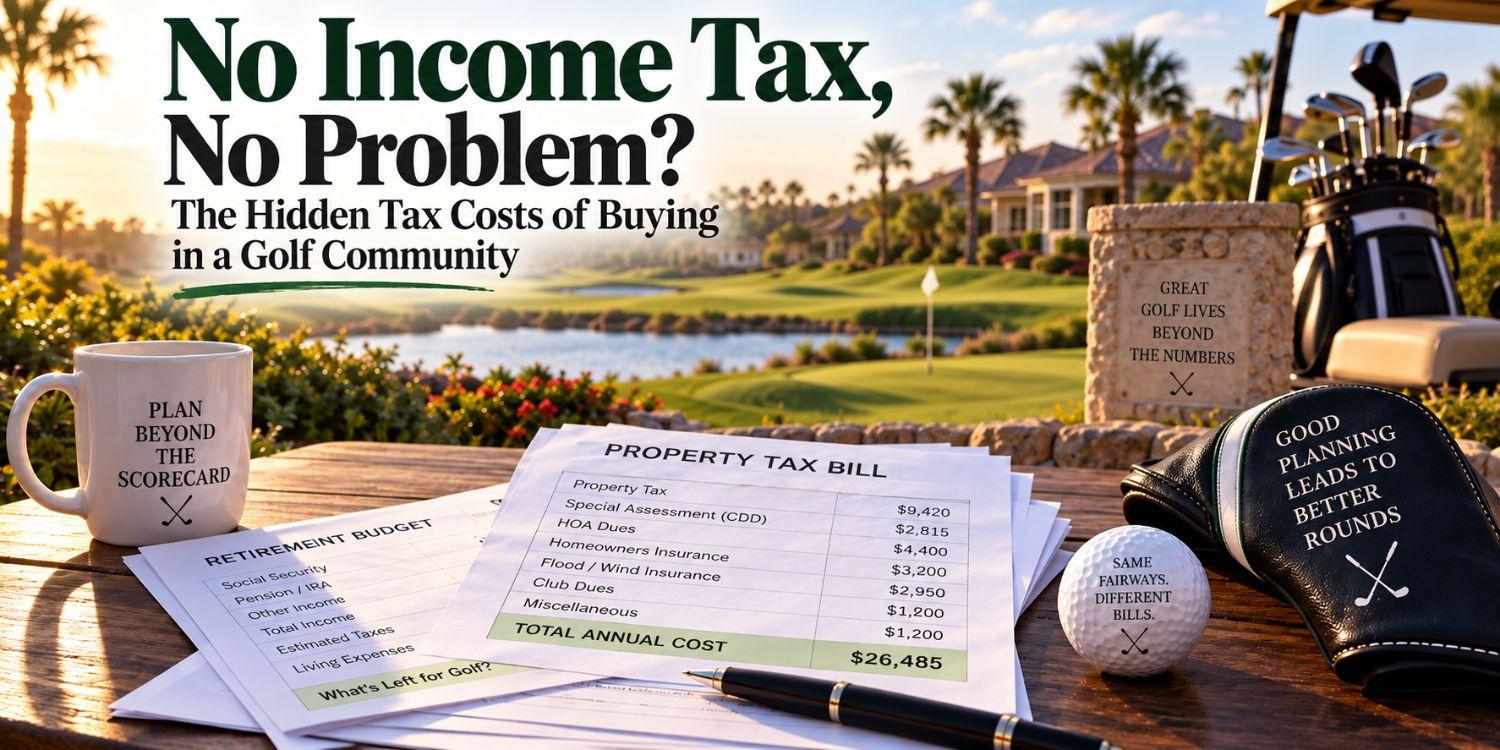
In many newer Florida communities, a Community Development District (CDD) assessment appears right on the property tax bill. It pays off the bonds that built the roads, the pipes and sometimes the amenities. Add HOA dues, club dues, initiation fees and the occasional special assessment for a new clubhouse or a bunker renovation, and the "tax" of living in the community can rival what you pay the county. Ask for the full assessment history and the reserve study before you buy.
5. Sales Tax Adds Up in the Good Life
Retirees in golf communities spend money: dinners out, golf travel, golf carts and a steady stream of equipment that promises 15 extra yards. In high sales tax states like Tennessee and Washington, that spending comes with a meaningful surcharge. It won't usually outweigh an income tax savings, but it narrows the gap.
6. Insurance Can Erase Your Tax Savings
Homeowners and wind insurance along the Florida, South Carolina and Texas coasts has become a serious line item. It isn't a tax, but it hits your budget the same way. Get real quotes, including flood coverage, before you write an offer. A great tax state with an ugly insurance premium can end up costing more than a moderate tax state inland.
7. Estate Taxes Follow Your Real Estate
Moving to Florida doesn't necessarily free you from your old state's estate tax. If you keep a lake cabin in Minnesota or a cottage on the Cape, those states can tax that property when you die, even though you live somewhere else. With exemptions as low as $1 million in Oregon and $2 million in Massachusetts, it's worth a conversation with an estate attorney about how you hold that property.
Before You Buy: A Quick Checklist
- What is the effective property tax rate in this county, and what will the bill be after my exemptions?
- Will this be my legal residence, or a second home taxed at a higher rate?
- Are there CDD, special district or bond assessments on the tax bill?
- What are the HOA and club dues, and what special assessments have there been in the past five years?
- What will homeowners, wind and flood insurance actually cost here?
- Do I own property in any state with an estate or inheritance tax?
A tax friendly state is a great start. A tax friendly golf community is the goal. Do the full math, then enjoy the view from the 16th tee knowing you got it right.