
There is a version of this decision where you spend four months reading websites and still do not know the answer. Then there is the version where you fly into Savannah, play Deer Creek and Terrapin Point on back to back mornings, eat dinner at Palmer's, and figure out in three days what a hundred hours of research will not tell you.
The Landings runs a Discovery Visit for exactly this, and current pricing on it holds through September 15. That is the single most useful thing in this article, so it goes at the top instead of the bottom. Details are here: https://thelandings.com/plan-a-visit
Now here is what you should know before you go, including the parts the sales office will not lead with.
The Island Wakes Up Early
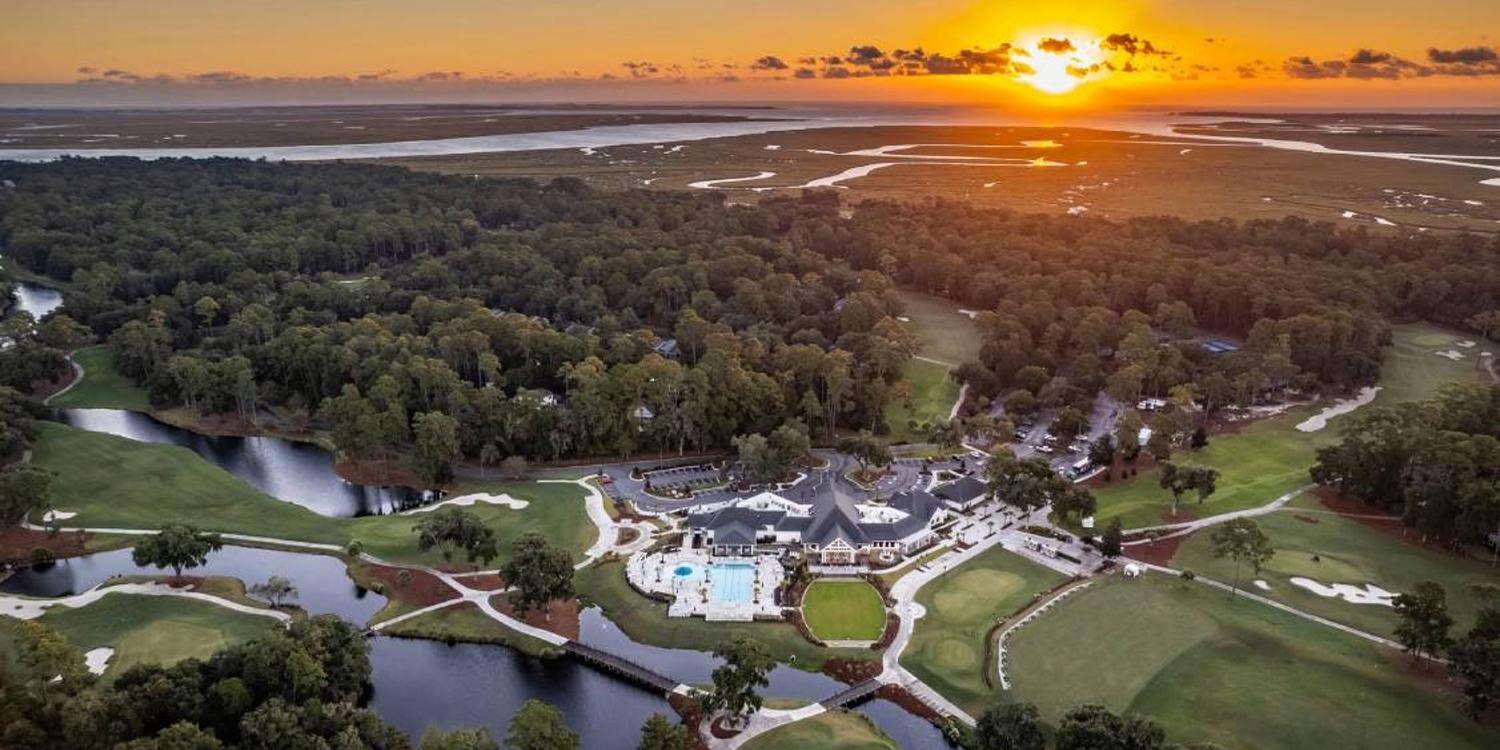
The 12th at Marshwood is a par three aimed straight at Romerly Marsh and Wassaw Sound, and at seven in the morning in October the tide is coming in behind the green and there is nobody in front of you. It is the prettiest shot at The Landings and the club has said so for fifty years. Down at the other end of the island, Terrapin Point runs out toward Adams Creek and Ossabaw Sound and finishes back at the Palmetto clubhouse. In between there is Oakridge, where the 15th hole has a family gravesite off the fairway and everyone calls it the Cemetery.
That is the case for the place, and it is a real one. Six courses on one island, four architects, and a golf cart is a legitimate way to get to all of them.
Where It Is
The Landings sits on Skidaway Island in Chatham County, Georgia, about fifteen miles southeast of downtown Savannah, on roughly 4,200 acres of maritime forest and marsh. The community puts downtown at twenty minutes and that holds outside of rush hour and St. Patrick's Day.
Know what kind of island this is. Skidaway is a marsh island on the Intracoastal Waterway, not an oceanfront one. You get tidal creeks, deepwater docks, and live oaks. You do not get a beach. Tybee is about forty minutes by car.
Savannah/Hilton Head International is thirty to thirty five minutes from the gate. As of July 2026 it serves 38 nonstop destinations across nine airlines: Allegiant, American, Avelo, Breeze, Delta, JetBlue, Southwest, Sun Country, and United, with Atlanta, Charlotte, and New York the heaviest routes. Watch one thing: Allegiant is closing its operating base at SAV in November 2026, which may thin some leisure service.
Healthcare is a genuine strength here and it is why a lot of people choose Savannah over a smaller Sun Belt town. Candler Hospital, part of St. Joseph's/Candler, is a 384 bed hospital on Reynolds Street with the Lewis Cancer and Research Pavilion on campus. Memorial Health University Medical Center on Waters Avenue runs the region's Level 1 trauma center. Both are twenty to twenty five minutes off island. Walk in urgent care sits at Sandfly on Skidaway Road, about ten minutes from the gate.
Groceries mean the Publix at The Village on Skidaway Island just outside the gates, open 7 a.m. to 9 p.m. daily. It is small and it costs more than the Kroger on the mainland. That is island life. For a real shop, or for hardware, you are fifteen to twenty minutes across the causeway.
The One Road In
Diamond Causeway, the GA 204 spur, is the only road connecting Skidaway Island to the mainland. It is two lanes and it carries every resident, contractor, delivery van, and ambulance. Congestion at peak hours is real, and an accident on the causeway can effectively isolate the island.
The old bascule drawbridge over Skidaway Narrows was replaced with a high fixed span, so nobody waits on a sailboat anymore. But the arithmetic does not change: one road, one bridge, coastal Georgia hurricane country. If you need to know there is a second way out, this is not your island. Ask The Landings Association directly about evacuation protocol before you write a check.
The Golf
Six courses, and they are not variations on a theme.
Marshwood opened in July 1974 as an Arnold Palmer and Frank Duane collaboration, redone by Tim Liddy in 2003. It is the tightest of the six. Magnolia, also Palmer, with Ed Seay, opened in stages in 1977 and 1979 and was restored in 2021 by Brandon Johnson of the Arnold Palmer Design Company. It is the only course on the property without marsh views, and the restoration put real movement in the greens, which means the shots that matter are from fifty yards in.
Arthur Hills built both Palmetto and Oakridge. Palmetto reopened after a 2023 restoration by Bill Bergin, who reangled holes to bring water into play and ringed the big greens with fall-offs that will make you learn a bump shot. Oakridge is the shorter, sportier one with the split level fairways Hills was known for.
Terrapin Point, by Willard Byrd, runs to the tip of the island and is the narrowest off the tee with straightforward greens. It is next in the renovation queue, with Davis Love III's name attached as of mid 2026. Confirm timing before you buy nearby, because a course renovation means a closed course for a season.
Deer Creek is the Tom Fazio course and the tournament venue. The Korn Ferry Tour's Club Car Championship is played there each spring, and the ATP's Savannah Challenger runs on the clay at Franklin Creek. That is real competitive golf in your backyard, not a marketing line.
For the daily player, the honest read is this: six courses is the whole argument for The Landings. A single very good course gets stale by year three when you are playing four times a week. Six does not. Practice is handled by a six-bay Golf Performance Center. Walking is available and a meaningful number of members do it, particularly the early morning groups. Ask the pro shop about tee time access by membership category and by season, because that is where the real answer lives and it will not be in a brochure.
Membership and Access
Two separate organizations, and confusing them is the most common mistake buyers make.
The Landings Association is the property owners association. Every owner is a member automatically. It runs security, roads, the two deepwater marinas at Landings Harbor and Delegal Creek, the dog park, trails, and storage. Its annual dues are set by owner vote in three year cycles, which is unusual and worth understanding, because it means dues are a community decision and the increases get argued about publicly. The Association does not publish current dues on its open website. Get the number in writing from them, not from a listing agent.
The Landings Golf and Athletic Club is a separate private club with its own initiation and annual dues. Per veteran golf writer Len Ziehm, reporting in June 2026, 2026 initiation fees run $80,000 for full golf, $50,000 and up for associate golf, $35,000 for national golf, and $40,000 for athletic. Those are initiation figures, not annual dues, and annual dues and food and beverage minimums are on top. The club does not publish annual dues publicly. Call the membership office at 912-598-8050 and get the current full sheet, including the transfer and refundability terms, before you fall in love with a house.
Confirm whether club membership is required with the specific property you are considering. That single question can swing your cost by five figures a year.
Homes
The Landings is not age restricted. It is an all ages community with roughly 4,350 homes and around 8,000 residents, and it includes working professionals who commute to Savannah, not only retirees.
Product runs from townhomes to large custom marsh-front and golf-front houses across five campuses: Marshwood, Palmetto, Oakridge, Deer Creek, and Franklin Creek. Per Redfin, the median sale price in The Landings was $864,709 as of May 2026, up 8.1 percent year over year. Homes were selling in the neighborhood of two months and generally a few percent under list. That is the market as reported, not a forecast, and nobody should read a past appreciation figure as a promise.
Georgia treats retirees well. The state does not tax Social Security and offers a substantial retirement income exclusion starting at age 62. Chatham County's long-running Stephens-Day floating homestead exemption freezes the taxable value at the year you establish the homestead, which over a fifteen year hold is worth more than most buyers realize. Two things to note plainly: it applies only to a homesteaded primary residence, and Georgia property tax rules changed with HB 581 in 2025. Take the actual numbers to your own accountant. This article is editorial, not tax advice.
Amenities Beyond Golf
Racquet sports here are not an afterthought, which matters because for a lot of couples the non-golfer's answer decides the move. The club has 31 tennis courts, eleven of them lighted, across three locations, and describes Franklin Creek as the largest residential clay court facility in the country. Pickleball has gone from 80 players in 2017 to over 750 active players. As of early 2026 there were 15 pickleball courts with expansion to 22 planned. There are also eight bocce courts made of ground oyster shell, plus croquet and platform tennis.
Wellness is a 52,000 square foot center with five pools. Dining runs to roughly ten venues across four clubhouses, including Palmer's Steakhouse and Arnie's Tavern, and The Deck at Franklin Creek with a pool and water slides for when grandchildren visit.
On the water, the Association's two deepwater marinas give you direct Intracoastal access. If you have a boat, this is a differentiator most inland golf communities cannot touch at any price.
For aging in place: the island is genuinely golf cart navigable, single level homes exist in quantity, and The Marshes of Skidaway Island, a life plan community, is on the island itself. That last one matters more than people admit until it matters a lot.
The Seasons
October, November, March, and April are the reason people move here. Low seventies, low humidity, and the golf is as good as it gets in the Southeast.
Then there is the rest of the year. July and August are hot and heavy, with highs in the low nineties, real humidity, and afternoon thunderstorms that will chase you in. Coastal Georgia gnats and no-see-ums are a spring and fall reality and locals plan around them. Winters are mild, with highs in the upper fifties and low sixties and a hard freeze once or twice, so golf is a twelve month proposition, but December and January mornings can genuinely be too cold to enjoy before ten.
Hurricane season runs June 1 to November 30 with the peak from August through October. This is not theoretical here. After Hurricane Matthew in 2016, Landings owners voted a Community Recovery Special Assessment, and the voting packet is still posted in the Association's public resources. That is exactly the kind of thing a sales office does not lead with and exactly what you should know. Storm exposure also drives wind and flood insurance costs, so get a real quote on the specific address early in your process, not after you are under contract.
As a Second Home
This is where The Landings gets very clear, and the clarity cuts both ways.
Short term rental is not allowed. In 2014 owners voted a covenant restricting rentals to residential purposes only. The language prohibits renting for timeshare, fractional, or hotel purposes, and prohibits renting less than the entire dwelling. In practice, hotel purposes means fewer than 30 days, so Airbnb and VRBO style weekend income is off the table. If your model depends on nightly rates during Masters week or St. Patrick's Day, buy somewhere else.
What is permitted is longer term leasing. The Landings Company runs an in-house rental program with 30 day minimum leases; its published materials list typical rents of $3,500 to $6,200 per month depending on the home and market, a 14 percent management fee, a $750 startup fee, and a recurring $400 annual linen fee, with rent including utilities, landscaping, pest control, trash, internet, and television. Those are the program's own figures as published and current as of this writing. The program also cites average occupancy of roughly nine months per year. Treat that as a sales figure until you see actual statements on comparable homes, because occupancy averages are the single most oversold number in this business.
Two things I could not verify and you should ask directly. First, what club access a tenant gets and at what cost, since that materially changes what your home rents for. Second, exactly what continues to be billed while the house sits empty, including club dues and any food and beverage minimum. Get both in writing from the club, not the listing agent.
Then run the real annual number: Association dues, club dues if membership attaches, property taxes at the non-homesteaded rate without Stephens-Day protection, wind and flood insurance on a coastal property, management, and maintenance. Rental rules also get amended and enforced unevenly, so read the covenants and current regulations before closing, not after.
Who It Fits, and Who It Does Not
It fits the golfer who plays three or four times a week and would get bored on one course. It fits a couple where one plays golf and the other plays pickleball or tennis, because both get a real program here, not a token court. It fits people who want a city with a hospital system, an art school, and restaurants twenty minutes away. It fits boaters, emphatically.
It does not fit someone who wants a beach out the back door. It does not fit anyone who needs to escape summer humidity, or who has decided in advance that a single causeway is an unacceptable risk. And it does not fit an investor looking for nightly rental income, because the covenants closed that door in 2014 on purpose.
Back to the Visit<
Everything above is the homework. None of it tells you whether you like the people in the group ahead of you on the 15th tee, and that is the thing that actually decides whether you are happy here in year six.
So go. Book the Discovery Visit before September 15 to lock in current pricing, and schedule it for October or November if you have the flexibility, when the weather is honest and the tee sheets are busy enough that you can see how the place really plays.